
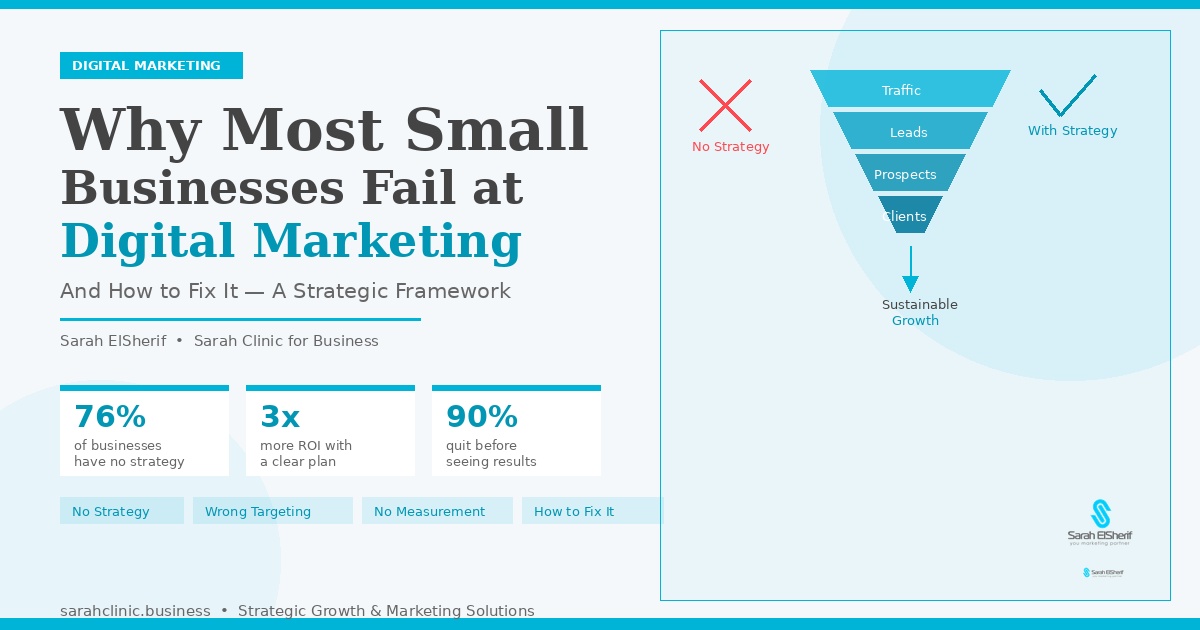
Why Most Small Businesses Fail at Digital Marketing (And How to Fix It)
After more than 20 years of working with businesses across different industries, I’ve seen the same pattern repeat itself hundreds of times. A motivated business owner invests time and money into digital marketing, sees little to no results, and eventually concludes that “digital marketing doesn’t work for my business.”
The truth? Digital marketing works. The execution is what fails.
Here are the most common reasons small businesses struggle — and exactly what to do instead.
1. They Start With Tactics, Not Strategy
The most common mistake I see is businesses jumping straight into execution — running Facebook ads, posting on Instagram, sending emails — without a clear strategy connecting all these efforts.
Tactics without strategy are just expensive experiments.
Before you spend a single pound or dollar on digital marketing, you need to answer three fundamental questions:
- Who exactly is your ideal customer?
- What specific problem do you solve for them?
- Why should they choose you over every alternative?
Once you have clear answers, every marketing decision becomes easier and more effective.
2. They Target Everyone — Which Means They Reach No One
“Our product is for everyone” is the most dangerous sentence in marketing. When you try to speak to everyone, your message becomes so generic that it resonates with no one.
The businesses that grow fastest are the ones with the most specific targeting. Instead of “women aged 25-45,” think “female entrepreneurs in Egypt running service-based businesses with 1-5 employees who struggle with client acquisition.”
The more specific your audience, the more powerful your message, the lower your cost per lead, and the higher your conversion rate.
3. They Expect Immediate Results
Digital marketing is not a vending machine. You don’t put money in and get customers out the next day. Building a sustainable digital presence takes time, consistency, and patience.
Most businesses give up right before the results start showing. They run ads for two weeks, see no immediate sales, and stop. They publish five blog posts, get no traffic, and abandon the strategy.
The brands that win online are the ones that commit to a 6 to 12 month strategy and execute it consistently, adjusting based on data rather than emotion.
4. They Ignore Their Data
One of the greatest advantages of digital marketing over traditional marketing is the ability to measure everything. Yet most small businesses never look at their analytics.
They don’t know which pages on their website convert best. They don’t know where their traffic comes from. They don’t know which ads are profitable and which are burning money.
Start with the basics: Google Analytics for website behavior, Meta Ads Manager for social advertising performance, and Google Search Console for organic search visibility. These free tools contain everything you need to make smarter decisions.
5. They Underinvest in Content
Content is the foundation of every successful digital marketing strategy. It’s what attracts organic traffic, builds trust with potential customers, and positions you as the authority in your field.
Yet most small businesses treat content as an afterthought — posting sporadically, writing short low-value articles, or copying content from competitors.
High-quality content that genuinely helps your target audience will outperform paid advertising in the long run, every single time. One well-researched, comprehensive article can drive consistent traffic for years.
6. They Don’t Have a Clear Conversion Path
Getting traffic to your website means nothing if visitors don’t take action. Many small business websites are beautifully designed but have no clear conversion path — no obvious next step for the visitor to take.
Every page on your website should have one primary goal and one clear call to action. Whether that’s booking a consultation, downloading a free resource, or making a purchase — make it obvious, make it easy, and make it compelling.
The Fix: A Simple Framework That Works
After two decades of testing strategies across dozens of industries, the framework that consistently delivers results is straightforward:
1. Define — Know exactly who you serve, what you offer, and why it matters. 2. Attract — Use content, SEO, and targeted advertising to reach your ideal customer. 3. Convert — Turn website visitors into leads with clear offers and compelling calls to action. 4. Nurture — Build relationships through email marketing and consistent follow-up. 5. Measure — Track your key metrics weekly and adjust your strategy based on what the data tells you.
Digital marketing is not complicated. But it does require clarity, consistency, and a genuine commitment to providing value to your audience.
If your business is struggling to get results online, the problem is almost never the platform or the budget — it’s the strategy. Get that right first, and everything else becomes significantly easier.






No comment